What we build
The operations system
your company runs on.
One build, shaped around how your company already works, scoped after a free audit and shipped in stages. Below is what that means: what gets drawn, what gets made, what you own at the end, and what we will not touch.
Get my free ops auditSix questions, about two minutes.
On the call
- One job you know you lost, traced from the ring that started it to the invoice that never came.
- The three points where it broke down, named rather than guessed at.
- You leave with the drawing of it, whether we ever work together or not.
Forty-five minutes. David takes these himself. Nothing for you to prepare and nothing to sit through.
Ways in
Three ways in, and you can stop after any of them.
They run smallest first, and each one ends with something in your hands. Starting at the top of this list does not commit you to the bottom of it.
The audit
You can feel that something is leaking, and you could not point at it if somebody made you.
What it takes
Free, and about 45 minutes of your time.
What you hold
A plain account of where your own jobs are getting lost, written down and yours to keep whether you go further or not.
The roadmap
You already know roughly what is broken. What you cannot settle is which piece to pay for first.
What it takes
Around two weeks of measuring, then one session to walk you through what it found.
What you hold
A ranked list of what each gap is costing you, with the argument for closing one before the others.
The build
The order is settled, and what you want now is somebody to go and build the thing.
What it takes
Typically five figures. Delivered in stages, so your team is using part of it while the remainder is still being made.
What you hold
The running system, yours outright, and the weekly numbers to hold it to.
The six steps further down are this same road drawn in more detail. These three are the places you are allowed to get off it.
Three things that are true in most companies this size.
- A date gets promised before anyone checks what the supplier can actually deliver, because the lead time lives in one person’s head.
- Nobody can say when the crew will arrive, so the homeowner is told a time that was invented on the spot.
- A finished job waits weeks to be billed because nothing tells your accounting system it is finished. Closing the job out is what sends that signal.
Fit
Worth building where one job has to survive a dozen handoffs.
Two companies can bill the same and need completely different things. The question that decides it is how many people, permits, suppliers and moving parts one job has to survive before it is finished and paid.
Build it if
- Somebody in the company sells for a living, and would be working inside what we build.
- You are past $1M and still climbing, with six or more people on the payroll.
- A single job changes hands several times: office, estimator, crew, subcontractor, supplier, invoice.
- You are still the person the day routes through, and it is capping what the company can take on.
Do not build it if
- Nobody sells full time. There is no seat for the system to be built around.
- You are under $1M. Tightening the process by hand will close more of the gap than a build will.
- Fewer than six people, and the whole week still fits in one head. Leave it there while it does.
That last rule loses us business and it is printed here anyway. Under six people there is no handoff to instrument. The work still moves through one head, and a system built to watch one person think is an expensive way to be told what you already know.
What you get
Six things exist afterwards that do not exist now.
This is the list a proposal turns into. None of it is a licence, a seat or a subscription to us, and the system that comes out the far end belongs to the company it was built for.
The process map
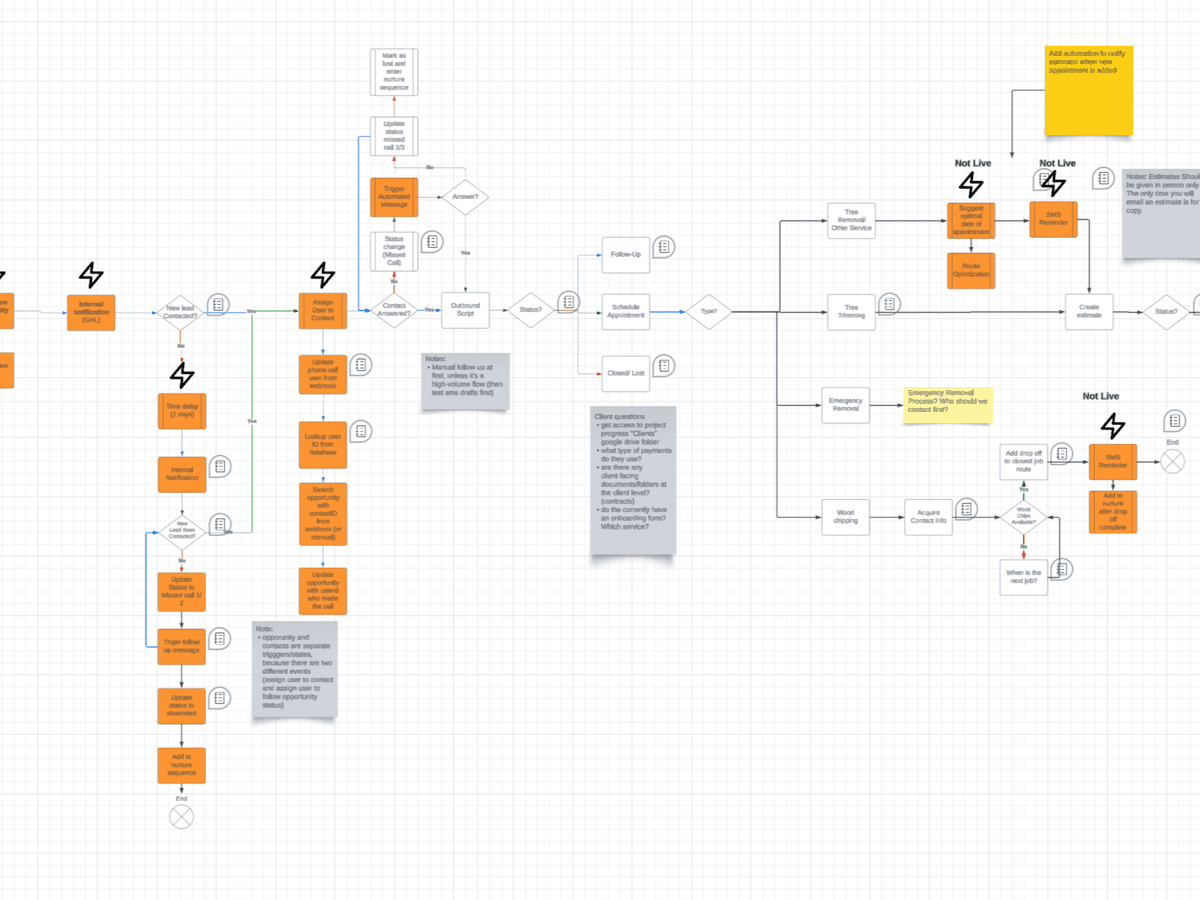
Your operation on one page: who does what, which tool it happens in, and every seam where a job passes from one pair of hands to the next. You keep the file. It is also where the knowledge currently sitting in three people’s heads gets written down, which matters most on the day one of them leaves.
The ranked roadmap
Each gap we find arrives with three numbers against it: what it is worth over a year, what it will take to build, and how long before it has paid for itself. They come in the order we would work them, with the reasoning printed beside each one, over a 3, 6 and 12 month horizon.
A prototype you click through
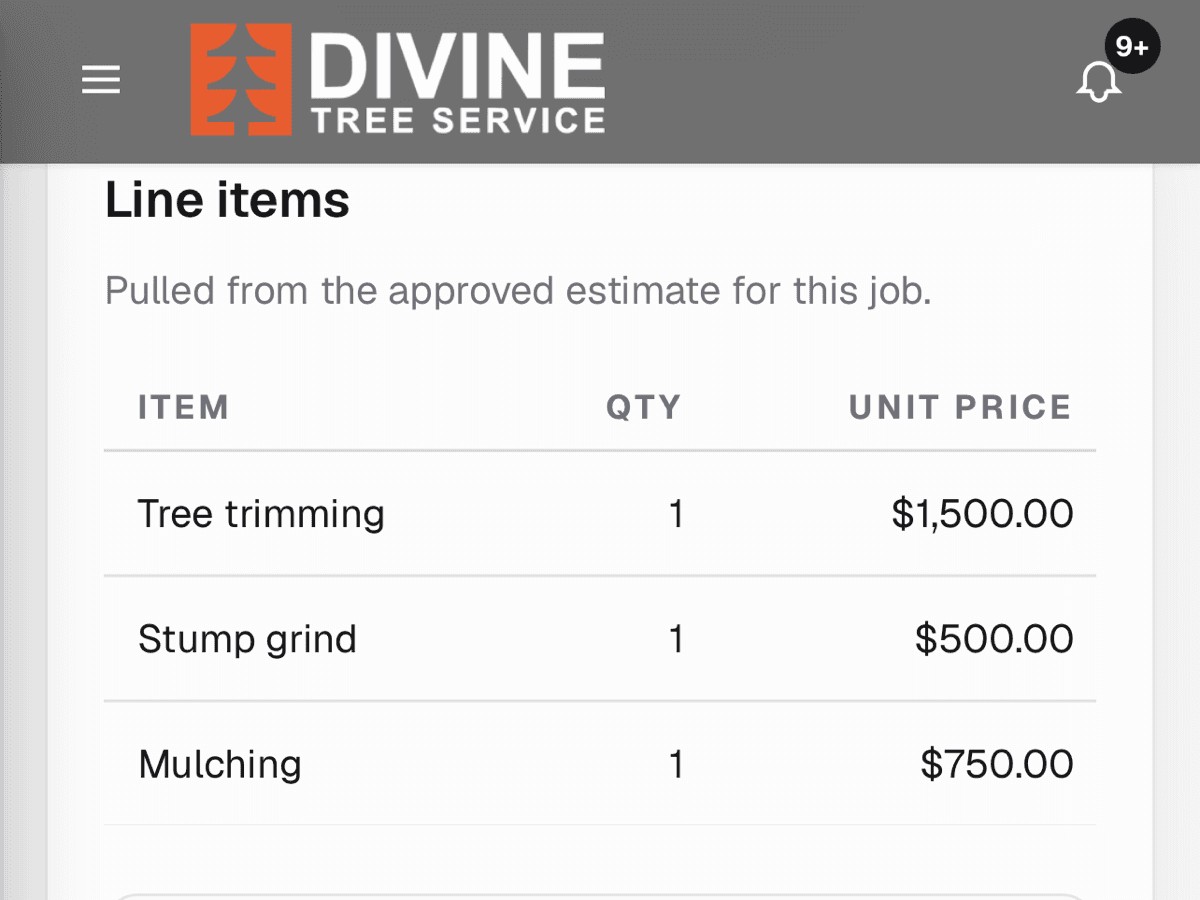
Before anything is coded, your team walks the real screens and says where they are wrong. Wrong at that stage costs an afternoon. Wrong two sprints later costs a great deal more, which is the entire reason this step exists.
One place the truth lives
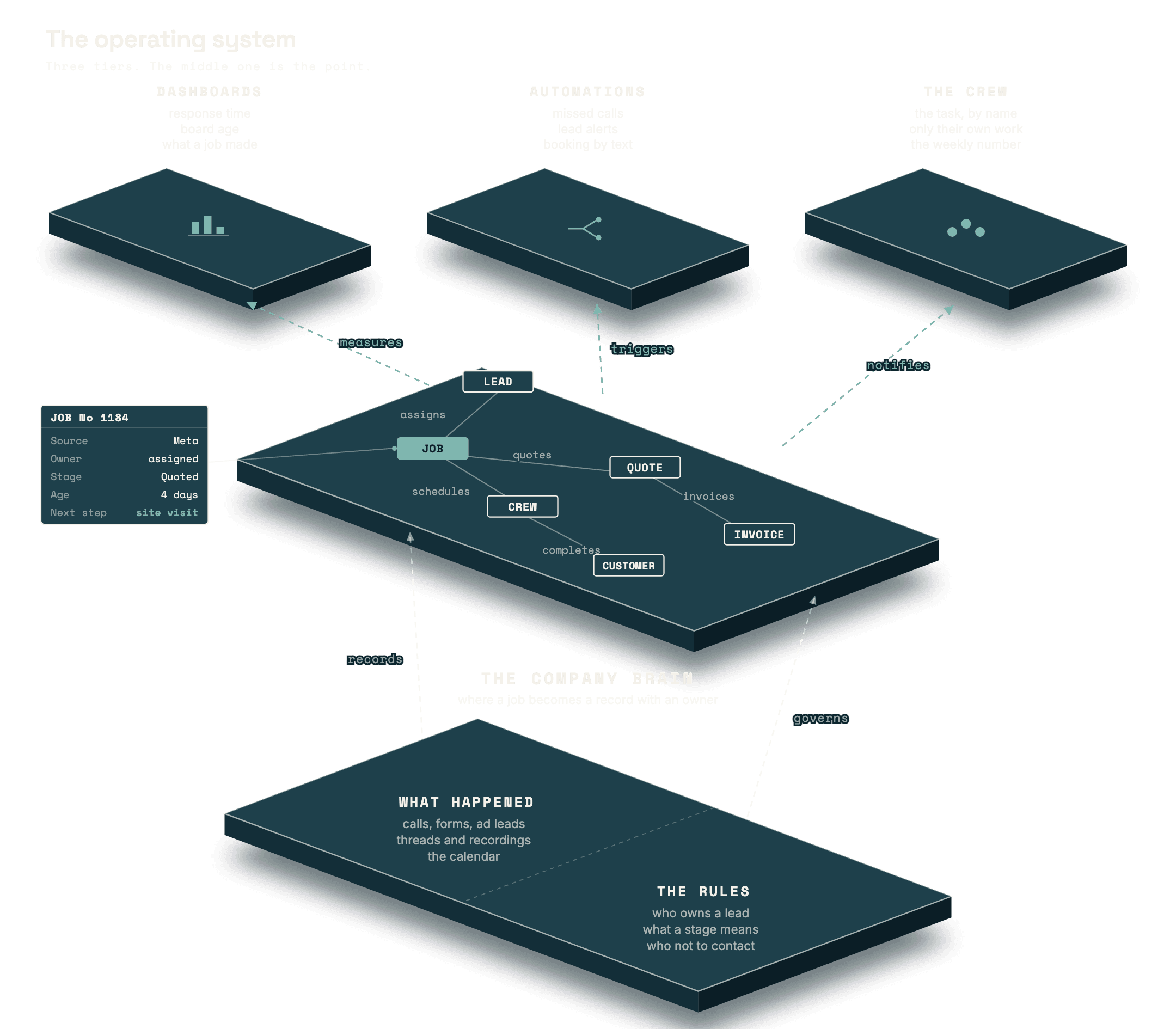
Jobs, contacts, quotes and invoices stop being messages and become records, each with an owner, a stage and a history. Crews open only their own work. A manager sees what is stuck. You see capacity, and what a finished job actually made.
On your own tools, where they can carry it
No crew is asked to download anything. Where the calendar, the CRM and the phone lines can already do the work, that is where it runs, which is why almost none of it needs training. Anything they genuinely cannot carry gets built instead, and the audit names which is which before you commit to anything.
The tracking, and the baseline under it
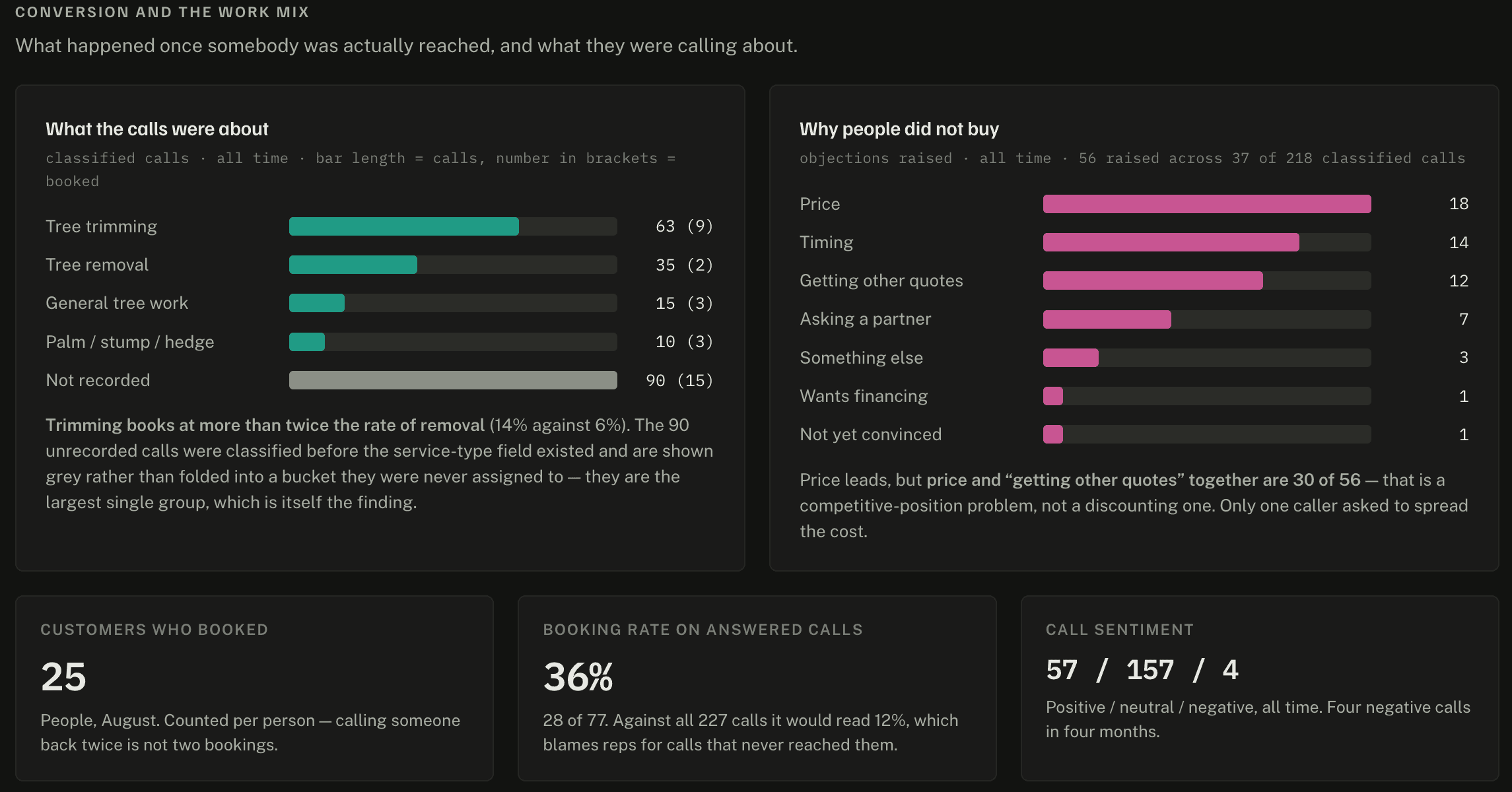
How the operation performs today gets recorded before a line of code is written. Those same measurements come back every week, and a full report lands at 30 days, 60 and 90. A piece that is not moving its number surfaces there without anyone going looking.
You own it. That is the point of building rather than renting: the thing your company scales on is not something that can be repriced, retired or migrated out from under you by a vendor.
The process map
The prototype
The scoreboard
Scope
What is not in it.
Scope arguments happen because nobody wrote down the edges. Here are ours, before a call rather than after a contract.
A new CRM
We are not here to pull out something you already paid for. Where a tool genuinely is in the way, that turns up in the audit as a finding, and a finding is not a sales step.
Your books
Accounting and invoicing stay where they are. We connect to that system. We do not try to become it.
An advertising channel
Ads are proof around here, never the product. One client’s paid channel was ours to build and to run, and it did perform, but it existed to feed a system that could already cope with what came out of it. Selling you leads is somebody else’s business.
The trade itself
We do not climb, wire, frame or roof, and nobody here pretends to. Our end of it is the route a job takes between the first ring and the last invoice, and where along that route it gets dropped.
A hire, or a box of hardware
Nothing arrives on a pallet and nobody new appears on your payroll. If a person really is what the company needs next, the audit will say that out loud.
The shape of it
What the six steps below are building toward.
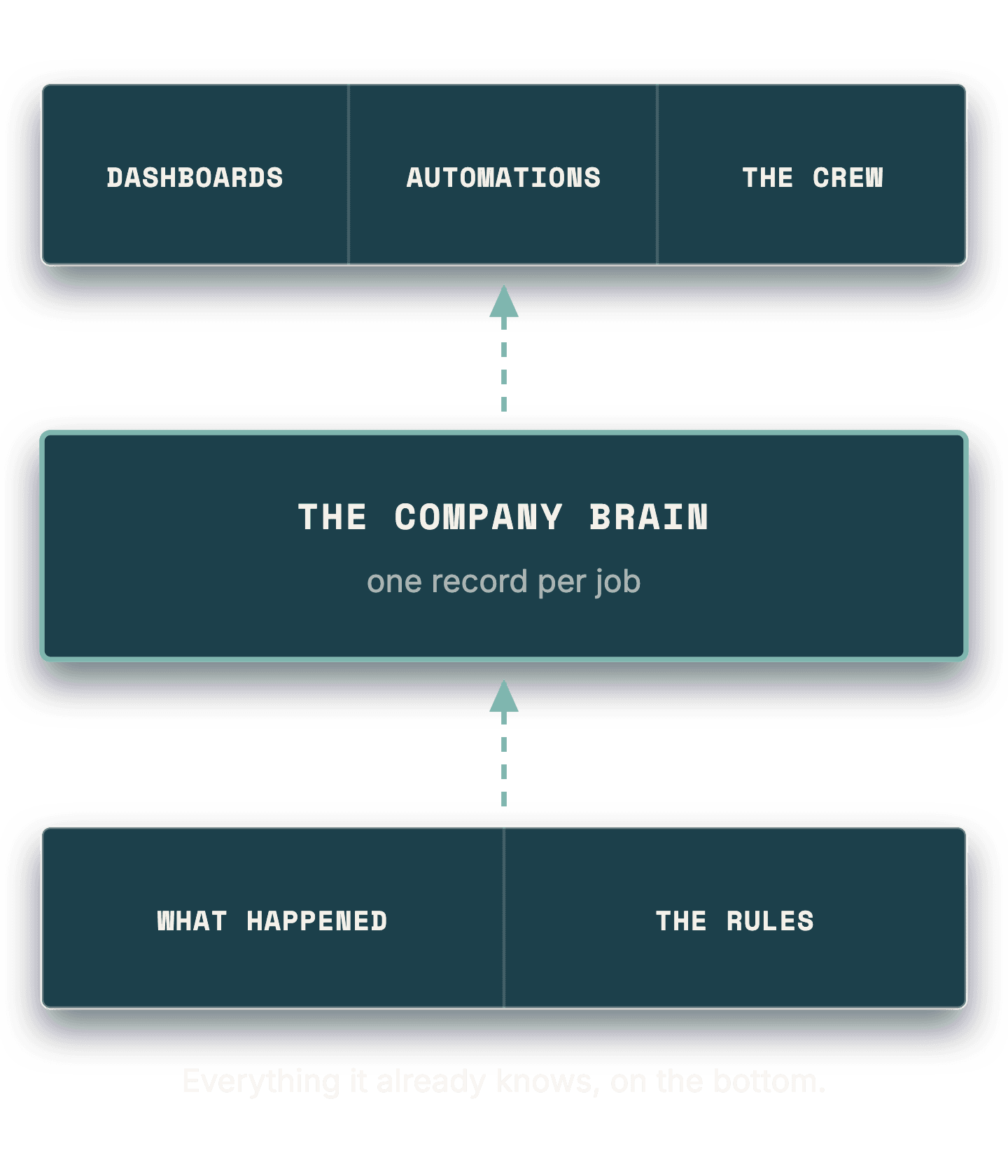
Before the sequence, the destination. Every engagement ends with some version of this picture: what your operation already records and the rules it already runs on, both feeding one shared account of every job, with the reporting, the automation and the crew all reading from that one account instead of from each other.
Sequence
Six steps. The first is free and you may stop there.
Three of these are the method itself: Map, Identify, Deploy. The other three are the free audit in front of it, the prototype that stops us building the wrong thing, and the measurement that says afterwards whether it worked. Nobody signs anything to reach step 02, and plenty of companies get what they needed out of step 01 and go away. That is a fair outcome and it costs us a morning.
- 01
The audit
About 45 minutes. Free.
I run this one myself. One job, walked from the ring to the cleared invoice, and the three places work is falling out of it. Nothing to prepare, no deck, nobody demonstrating software at you. It is also where the price of all of this comes from, which is why the figure further down this page is a magnitude and not a quote.
- 02
Map
Around two weeks.
Every workflow measured against the record your own systems already kept, not against what anybody remembers in a meeting. For trades that includes riding along, because whiteboards, group texts and sticky notes are part of the process whether or not anyone calls them that.
- 03
Identify
Reported back in one session.
Every gap gets a number against it, and the number is usually the surprise. It is rarely one big leak. It is a handful of small ones nobody thought worth mentioning, which together come to more than the problem you originally called about. You see the whole list, what each item is worth over a year, and the order we would work it in. Some of what you asked for on the first call lands near the bottom, with the reason written beside it.
- 04
Design sprint
Before a line of code.
The prototype gets built and your team clicks through it. This is the cheapest opportunity anyone will ever have to say "that is not how we do it here", and it is the step that stops us building the wrong thing beautifully.
- 05
Deploy
A 30 to 90 day MVP, in sprints.
Whatever needs the least integration and returns the most goes first, so something is working for you while the rest is still on the bench. At Divine Tree Service the whole build was live about six weeks in.
- 06
Measure
Weekly, then 30, 60 and 90.
The numbers from step 02 come back with the new ones beside them. A piece that is not earning its keep turns up in your reporting before anybody here has to raise it, and we would rather turn that piece off than carry on invoicing for it.
Everything above starts with one call and one job. Nothing is quoted before it.
Get my free ops auditProof
What six weeks of it did at Divine Tree Service.
Three crews in Sacramento. Six weeks after kickoff the build was live, and in their first complete month of running on it they closed $54,155 of work at a 43% close rate. The leads were the same leads: no advertising added, no new channels, nothing bought. What changed was what happened to one after it arrived.
They were getting through about 150 leads a month before any of this. That went to 195 in the first month and 225 in the second, which is the busiest month they have had.
6 wks
from kickoff to the whole build running
63 sec
from a missed call to a message going back out
56 sec
from hanging up to a written record and the deal moved
24 h/wk
handed back to the owner personally, with no hire
Cost
What it costs, and what the number turns on.
Clients typically invest in the five figures, depending on scope and what the audit finds. Nobody can be more precise than that before walking your operation, because two companies of the same size can need entirely different builds. One is losing work on the phone. The other is losing it in the gap between an approved estimate and a crew that never got told. Quote those two the same and one of them is being overcharged.
The shape does not move, though. You pay once for the build, scoped as a project and shipped in stages, so the first working piece is in use long before the last one is finished. After go-live the only recurring line is maintenance and support: keeping what runs running, and being on the other end when something needs a hand. Anything you decide you want later is priced separately when it comes up, never quietly folded into what you already pay. There is no seat count, nothing to license, and no year that you are signed into.
You will see the real figure before you agree to anything, and reaching it costs you nothing.
Guarantees
Two of them,
and the second one costs us.
On the roadmap
If it tells you nothing you did not know
The ranked roadmap exists to surprise you. If it comes back and every gap on it was already obvious, you do not pay for that phase.
On anything we build
If a piece is not moving its number
Every piece is built against a number and measured from before it existed. One that is not moving that number gets switched off and drops out of what you pay. You will have seen it in your own weekly report before we raise it.
Neither of those is a refund of the whole build, and we are not going to imply otherwise. The map, the roadmap and every piece that is doing its job remain yours.
Alternatives
The four other things you could do instead.
All four are real options and one of them may well be yours. It is worth being able to say why you picked it.
Nothing
The cheapest option on the list and the one with no invoice attached, which is why it usually wins. It still has a price. It arrives as a quieter quarter, an estimator on the freeway, and the jobs you never found out you lost. The real risk is rarely the money spent getting this right. It is the six months spent solving it the wrong way.
Hire someone to run the office
A legitimate answer and sometimes the correct one. Worth knowing it is not the only one available: at Divine Tree Service there was no office manager, and routing took the owner off the switchboard without anybody being hired. 24 hours a week came back to him personally.
Buy another tool
The easiest thing to try, which is how companies end up with ten or fifteen of them. The ceiling arrives long before the monthly cost does: every tool keeps its own version of the truth, none of the versions agree, and the next requirement means one more subscription and one more export.
Hire an agency
You may have done this already and got very little back. What is different here is the part you get to hold us to: your numbers are recorded before anything is built, the same ones return every week, and the reports at 30, 60 and 90 either show movement or show its absence.
Questions
What owners ask before they commit.
Next
Bring the job
that got away.
About forty-five minutes on one call, and nothing for you to get ready beforehand. At the end of it you have a drawing of where your own work is falling out. It costs nothing, it obliges you to nothing, and it is yours to act on whether or not we ever speak again.
It is also the only way anybody gives you an honest number for the build, which is why it comes first and why it costs nothing.
On the call
- One job you know you lost, traced from the ring that started it to the invoice that never came.
- The three points where it broke down, named rather than guessed at.
- You leave with the drawing of it, whether we ever work together or not.
Forty-five minutes. David takes these himself. Nothing for you to prepare and nothing to sit through.
Six questions, about two minutes.
See what six weeks of this built for a tree care company